Every time an agricultural researcher runs a D² genetic-divergence analysis, clusters a set of germplasm lines, or trusts a crop-yield estimate built from samples rather than a back-breaking total count, they are standing on the shoulders of one extraordinary man. This 29 June — observed across India as National Statistics Day — we at Agri Analyze celebrate the birth anniversary of the father of Indian statistics, Prasanta Chandra Mahalanobis (1893–1972).
A survey that almost didn’t happen
Picture Bengal in the late 1930s. Jute is the province’s economic lifeline — woven into the sacks that carry the world’s grain — and the government desperately needs to know how many acres are under the crop and how much it will yield. The accepted method is brute force: send enumerators to walk every field across millions of acres. It is slow, ruinously expensive, and never quite finished in time.
A young physicist-turned-statistician had a radical idea. Why count everything, when you can scientifically sample a small fraction of the land, measure it carefully, and estimate the whole with known precision? Mahalanobis designed exactly such a survey — laying out a grid of randomly located plots across Bengal, a technique we now call grid sampling.
The bureaucrats were horrified. How could a handful of small plots possibly speak for a crop grown across an entire province? The survey was nearly shut down before it could prove itself.
Then came an unlikely rescue. In 1938, the legendary British statistician R. A. Fisher — the man who gave us analysis of variance and the very logic of experimental design — visited India. Recognising the brilliance of what Mahalanobis was attempting, Fisher personally backed the sampling approach in a memorandum to the Viceroy. The survey survived. In 1940 the full large-scale sample survey of jute acreage across Bengal went ahead, and it worked spectacularly: faster, cheaper, and more accurate than total enumeration.
That single act of statistical courage became the seed of the National Sample Survey — the system that, to this day, helps a nation of more than a billion people measure its crops, its economy, and its people. The methods Mahalanobis battled to defend in the jute fields are the direct ancestors of the crop-estimation surveys that underpin Indian agricultural statistics even now.
From a missed train to a journal that changed his life
Mahalanobis’s path into statistics was almost accidental. Born on 29 June 1893 into a culturally vibrant Brahmo family in Calcutta, he trained as a physicist — graduating with honours from Presidency College, where his teachers included Jagadish Chandra Bose and Prafulla Chandra Ray, and his juniors included Meghnad Saha and Subhas Chandra Bose.
He then sailed for England to study at Cambridge. As the story goes, after missing a train he ended up staying near King’s College, was captivated by its chapel, and decided to enrol there, where he would later cross paths with the mathematical prodigy Srinivasa Ramanujan.
The true turning point came quietly. Browsing the library, Mahalanobis discovered Biometrika, the pioneering statistics journal founded by Karl Pearson. He was so taken with it that he bought a complete set of back issues and carried them home to India. On the long voyage back, he began applying these brand-new statistical ideas to problems in meteorology and anthropology. A physicist had become, in his own words, a statistician by instinct.
His gifts to statistics — and to agriculture
The Mahalanobis distance (D²): a tool breeders still reach for
In 1936, Mahalanobis introduced what remains his most famous contribution: a way to measure the distance between a point and a distribution — or between two groups — that accounts for the correlations among variables rather than treating them as independent. Born from his anthropometric studies, the Mahalanobis distance, or D² statistic, is today a cornerstone of multivariate statistics, pattern recognition, classification, and outlier detection across data science worldwide.
For the agricultural research community, this is not just history — it is daily practice. Open almost any modern paper on genetic divergence in crop germplasm and you will find Mahalanobis’s D² at its heart. Plant breeders use it to quantify how genetically distant their genotypes are across many quantitative traits at once, then group lines into clusters (often by Tocher’s method) to identify which divergent parents are worth crossing in a hybridization programme. Green gram, sorghum, soybean, blackgram, tomato, apple, pomegranate — across crop after crop, D² is the lens through which diversity is measured and breeding decisions are made. The statistic Mahalanobis derived from skull and body measurements in the 1930s is now quietly steering crop improvement in the 2020s.
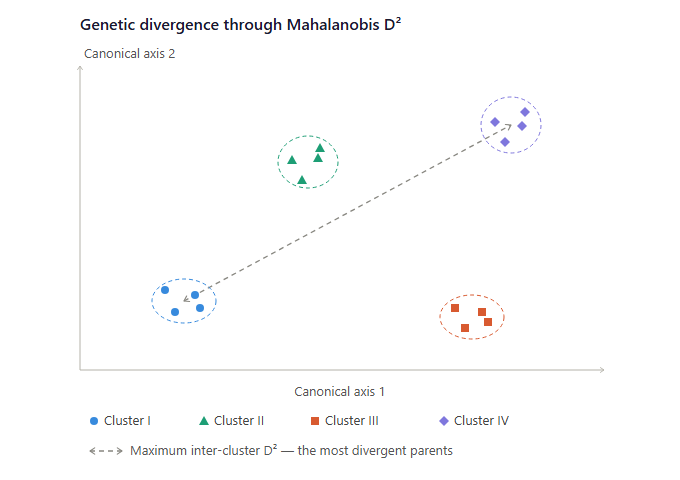
Mahalanobis’s D² groups genotypes into clusters by their genetic distance across many traits at once; the most divergent clusters (here, I and IV) point breeders toward the most promising crosses.
The sample-survey revolution
Mahalanobis is rightly celebrated as a pioneer of large-scale sample surveys. He championed the now-fundamental idea of the pilot survey — a small trial run to refine methods and costs before committing to a full study — and developed sophisticated thinking about how to balance the cost and precision of a survey by choosing the right size and number of sampling units. His crop-cutting experiments and grid-sampling designs laid the groundwork for how agricultural production is estimated in India to this day.
An institution-builder of rare ambition
A great method needs a great home. In 1931 Mahalanobis founded the Indian Statistical Institute (ISI) — which began life in a single room at Presidency College with a first-year budget of just Rs. 238, and grew into one of the world’s foremost centres of statistical research, declared an Institute of National Importance. In 1933 he launched Sankhya, the Indian Journal of Statistics, which carried much of this pioneering crop-survey work to the world. He also helped establish the National Sample Survey and the Central Statistical Organisation, building the very scaffolding of India’s official statistics.
Statistics that shaped a nation’s plan
As a member of independent India’s first Planning Commission, Mahalanobis brought rigour to economic strategy. His mathematical framework — the Mahalanobis model — became the analytical backbone of the Second Five-Year Plan (1956–61), embedding statistics into the heart of how a young nation imagined its own future. He was, as one biographer put it, a physicist by training, a statistician by instinct, and a planner by conviction.
The poet’s confidant
There is a softer side to this story that agricultural science rarely tells. Mahalanobis was no narrow technician — he was a true renaissance figure, and one of his closest lifelong bonds was with the Nobel laureate Rabindranath Tagore.
They first met in 1910 at Santiniketan, when Mahalanobis was just seventeen. He went on to frame the constitution of Tagore’s Visva-Bharati University, served as its general secretary for over a decade, and acted as the poet’s personal secretary — accompanying him on travels through Europe, where their circle even intersected with Albert Einstein. Writing to his future wife, Mahalanobis described the relationship with disarming tenderness: it would be wrong, he said, to call Tagore merely his guru — “I love him” was the truer expression.
It is a reminder that behind the equations was a man who believed deeply in the union of science, culture, and the service of society.
A legacy measured across a nation
Mahalanobis received India’s second-highest civilian honour, the Padma Vibhushan, in 1968, was elected a Fellow of the Royal Society in 1945, and earned recognition from statistical bodies around the world. He remained active in research until the very end, passing away on 28 June 1972 — a single day before his seventy-ninth birthday.
Since 2007, the Government of India has marked his birthday, 29 June, as National Statistics Day, ensuring that each year a new generation is reminded of how much a single visionary did to teach a country to count itself.
Why we celebrate him at Agri Analyze
Mahalanobis turned statistics from an academic curiosity into a practical instrument for understanding fields, farmers, and food. Every crop survey that informs national policy, every D² analysis that guides a breeder toward a promising cross, every sampling plan that lets a researcher say something rigorous about a whole population from a careful study of a part — each carries his fingerprint.
At Agri Analyze, that is precisely the spirit we try to honour: making powerful statistical methods accessible to the agricultural researchers who feed the world. So this 29 June, alongside the rest of India’s statistical community, we raise a quiet salute to the man in the jute fields who showed us that the right question, asked of the right sample, can reveal the truth about an entire nation. Happy National Statistics Day.
Reference
Indian Statistical Institute — biographical archives; Encyclopaedia Britannica, “P. C. Mahalanobis”; Government of India, Ministry of Statistics and Programme Implementation (National Statistics Day); Mahalanobis, P. C. (1940), “A sample survey of the acreage under jute in Bengal,” Sankhya.
The blog is written by:
Agri Analyze Team